How to Propagate Fuchsia from Stem-tip Cuttings in 2 Easy Ways
Some links in this post may be affiliate links
Fuchsia Plants are best propagated from stem-tip cuttings at the beginning of the growing season; they can be rooted either in water or in soil.
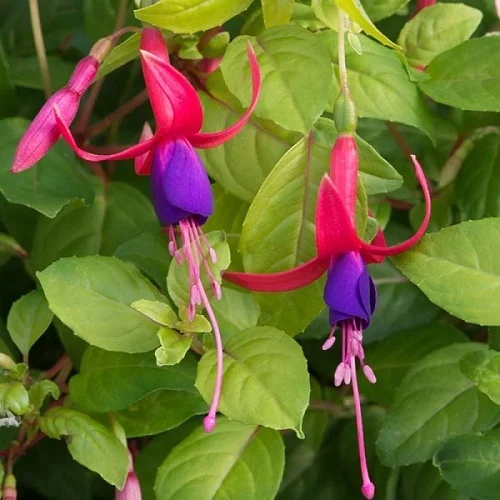
Fuchsia are among favorite flowering plants for hanging baskets on account of their very showy blooms whose sepals and petals may or may not be of the same color. The flowers may be single, semi-double, double bells or clustered blooms and are borne on drooping soft-stemmed bushes.
Fuchsias perform best in bright indirect light, warmth of 15-230C, humidity of 50-55% and consistently moist, rich, well-drained soil coupled with fortnightly feeding in spring and fall. Learn how to grow and care for Fuchsia hybrida.
Fuchsia Plants are easily multiplied by two easy propagation methods. Keep reading to learn more on these Fuchsia propagation methods.
1. Propagating Fuchsia Plants from stem-tip cuttings in water
- Take stem-tip cuttings of about 4-5 inches length from a healthy plant. Ensure each has several leaf node as this is where new growth will come from.
- Strip off the lower leaves and dip the lower cut end in a rooting hormone to hasten rooting.
- Place the cuttings in a jar of plain water or in a propagation station. Place in a warm, well-lit spot away from direct sunlight. Change the water every 5-7 days.
- When a good amount of roots have formed on the cuttings, transfer the cuttings into individual pots in moist rooting soil.
- Position the set up in a warm, well-lit place away from direct sunlight to prevent scorching.
- Maintain the soil moist until new growth has emerged and substantial growth has been observed.
- Transfer the new plant into a pot 1 size larger than the current one while ensuring that the soil is well-drained. At this point you can begin routine care as indicated herebelow.
2. Propagating Fuchsia Plants from stem-tip cuttings in soil
- Take stem-tip cuttings of about 4-5 inches length from a healthy plant.
- Strip off the lower leaves from the cutting. Ensure each has several leaf node as this is where new growth will come from.
- Dip the cut end of the cuttings in a rooting hormone to hasten rooting.
- Select a small pot about 6-8 inches wide. Ensure that the pot has a drainage hole to prevent the soil from getting soggy soil as it can lead to rotting.
- Fill the rooting container with quality, rooting soil. Moisten the soil lightly.
- With a pencil or similar object make a hole in the moist rooting mix. Insert the cutting in the previously made hole. Lightly cover the base of the cutting with the rooting mix.
- Cover the set up with polythene to create a greenhouse effect to increase warmth and humidity to enhance rooting.
- Position the set up in a warm, well-lit place and maintain the soil moist until new growth emerges and substantial growth has been observed.
- Rooting should take place in about 3-4 weeks; new growth indicates that rooting has taken place.
- Acclimate the new plant to normal growing conditions by opening the polythene cover a little bit everyday over a period of two weeks. During this period, keep the soil barely moist.
- Transfer the rooted cuttings into individual pots, 1 size larger than the current one and begin routine care. For a fuller plant, transfer several cuttings into one pot.
You liked it? Share on social media.
Related Content
Amazon Associates Disclosure
Homeplantsguide.com is a participant in the Amazon Services LLC Associates Program, an affiliate advertising program designed to provide a means for sites to earn advertising fees by advertising and linking to amazon.com.